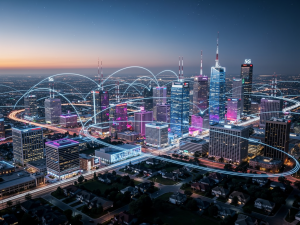
The Role of Connectivity in Modern Urban Planning: Insights from GeoTel

As cities expand and infrastructure ages, urban planning has rapidly evolved to meet the challenges of the 21st century. Today’s urban planners must tackle not just the physical framework of cities but also the increasingly critical dimension of digital connectivity. From broadband to 5G and the Internet of Things (IoT), connectivity is now woven into the fabric of effective urban development. GeoTel, a leading provider of telecommunication infrastructure data and geospatial solutions, is playing a central role in reshaping how planners approach digital networks as part of modern urban design.
Why Digital Connectivity Cannot Be Ignored in Urban Planning

Pexels
Historically, urban planning focused on primary infrastructures such as roads, water supply, and power grids. However, with the rise of smart cities and an increasingly internet-reliant society, connectivity is no longer optional. Robust telecom infrastructure is essential to support the growing demands for remote work, IoT-enabled devices, and smart city initiatives. GeoTel provides detailed datasets, including fiber routes, cell towers, and broadband nodes, enabling planners to incorporate telecom networks into broader infrastructure projects. This integration ensures that neighborhoods and urban developments are future-proofed against bandwidth demands and remain resilient in the face of climate and technological changes.
One key tool in urban planning is the use of urban digital twins, which are virtual models simulating the behavior of physical systems such as traffic, energy networks, and utilities. Despite their growing popularity, many digital twins ignore the critical layer of telecom and connectivity infrastructure. GeoTel’s advanced mapping solutions, like TeleTracker, enable planners to merge connectivity data with other layers, such as zoning, flood risks, and utility placements. This dynamic modeling ensures a comprehensive approach to urban design and enhances the reliability and utility of smart city initiatives.
GeoTel’s Contribution to Resilient and Sustainable Cities

Pexels
Sustainability and climate resilience are top priorities in contemporary urban planning. GeoTel’s telecom datasets provide valuable insights that help planners design low-carbon, smart spaces. With tools rooted in geospatial technologies and GIS mapping, GeoTel helps cities locate key infrastructures like distributed broadband nodes and fiber backhauls in climate-resilient areas. Efficient infrastructure placement mitigates the risk of outages and supports sustainable practices, including coordinated excavation or utility co-deployment.
For example, planners under the Tampa Bay Regional Planning Council showcased how climate-resilient designs are being integrated into urban scenarios with augmented reality (AR) models. GeoTel’s mapping data could enhance such visualizations by enabling transparency of fiber and network expansions, ensuring all stakeholders—residents, planners, and developers—are aligned. By visually incorporating telecom data into AR or virtual reality (VR) tools, planners can facilitate better public engagement and ensure inclusive urban development that embraces digital equity.
Future-Proofing and Smarter Collaboration

Pexels
As demand for digital infrastructure intensifies, urban planners need to think about future-proofing their designs. The integration of near-net and on-net fiber connectivity, redundant telecom pathways, and edge computing hubs ensures that emerging technologies like autonomous vehicles, smart IoT sensors, and AI-based systems can operate seamlessly. GeoTel provides precise and up-to-date telecom GIS information to help identify the optimal locations for new deployments and upgrades, saving time and resources for long-term projects.
GeoTel also bridges gaps between sectors such as transportation, utilities, and real estate, fostering cross-sector collaboration that is crucial for large-scale urban developments. By treating telecom infrastructure as an integral planning layer rather than an afterthought, planners can avoid inefficiencies like redundant excavation and future retrofitting.
To make urban projects smarter and more resilient, planners should follow a systematic approach: conduct baseline telecom audits, integrate connectivity data with other GIS layers, run modeling scenarios for co-deployment, and use visual tools to engage stakeholders. With its leading telecom GIS datasets and expertise, GeoTel empowers planners to bring about a digital transformation in cities by ensuring connectivity is at the forefront of decision-making.
Conclusion: Smart Cities Start with Smart Connectivity

Pexels
Modern urban planning is no longer confined to zoning policies or the development of physical infrastructure. It now demands a comprehensive strategy that weaves together physical and digital worlds. GeoTel stands out as an indispensable partner in this evolution. Its telecom infrastructure datasets, combined with geospatial mapping tools, allow planners, city officials, and developers to design sustainable, resilient, and connected urban environments.
Whether you are embarking on smart city projects, upgrading existing infrastructure, or designing new neighborhoods, the role of connectivity cannot be overstated. GeoTel not only makes complex network data accessible but also ensures its seamless incorporation into urban planning systems. By placing connectivity at the heart of planning, cities can be prepared for a future that demands both innovation and inclusivity.