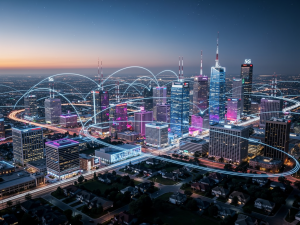
Verizon’s network strategy for 2025 is poised to redefine connectivity standards through aggressive infrastructure investment and technological innovation. As a dominant force in the telecommunications landscape, Verizon is orchestrating a multi-faceted plan that hinges on deepening its 5G footprint, expanding its fiber-optic backbone, and leveraging artificial intelligence for network autonomy. This comprehensive approach aims not just to enhance speed and reliability but to unlock entirely new economic and social applications. For consumers, businesses, and investors, understanding this roadmap is critical to anticipating the future of digital interaction and infrastructure. Consequently, we will dissect the core pillars, financial implications, and competitive dynamics shaping Verizon’s ambitious vision for the coming year.
Key Takeaways

- Verizon is accelerating its C-Band spectrum deployment to enhance 5G coverage and performance nationwide.
- A massive fiber-to-the-premises (FTTP) expansion is central to supporting both fixed wireless and future network demands.
- The integration of AI and machine learning is critical for achieving predictive maintenance and true network automation.
- Strategic partnerships and Open RAN (vRAN) adoption are key to increasing flexibility and reducing long-term costs.
- Verizon’s strategy directly targets enterprise and IoT revenue growth through tailored network slices and ultra-reliable services.
- Consumers can expect more seamless connectivity, but the real transformation will be in smart cities, autonomous systems, and industry 4.0.
Accelerating the 5G Revolution: Beyond the Hype

Verizon’s 2025 strategy places 5G at the absolute core of its growth narrative, moving beyond initial coverage claims to focus on performance and utility. The company is heavily investing in the continued rollout of its C-Band spectrum, which offers an ideal balance of coverage and capacity. This mid-band spectrum is the workhorse for delivering the promised high-speed, low-latency experience to both urban and suburban areas. Furthermore, Verizon is not just building a network for smartphones; it is architecting a platform for everything from connected vehicles to remote surgery. The goal is to transition 5G from a consumer novelty to an essential utility, much like electricity. In particular, the focus on standalone 5G core networks will be a game-changer, enabling advanced features like network slicing that were previously impossible.
Network Slicing and Enterprise Applications
A pivotal element of Verizon’s 5G roadmap is the full commercialization of network slicing. This technology allows Verizon to partition its physical network into multiple virtual, independent networks. Each slice can be tailored with specific characteristics for speed, capacity, latency, and security. For instance, a factory could have one slice for mission-critical robotic control with ultra-low latency and another for employee Wi-Fi and video surveillance. This capability is a direct answer to enterprise demands for customizable connectivity. Verizon is actively pursuing partnerships in sectors like manufacturing, healthcare, and logistics to deploy these tailored solutions. Consequently, a significant portion of future revenue is expected to flow from these business-to-business (B2B) and business-to-government (B2G) applications, rather than solely from consumer mobile plans.
The mmWave Conundrum and Densification
While C-Band forms the foundation, Verizon’s use of millimeter wave (mmWave) spectrum remains a key differentiator for ultra-high-capacity venues. However, the strategy for 2025 appears more nuanced and targeted. Deployments will concentrate on high-traffic, high-value locations such as stadiums, airports, convention centers, and dense urban corridors. The challenge with mmWave is its limited range and difficulty penetrating walls, requiring a dense network of small cells. Verizon’s plan involves accelerating this densification process, often in partnership with municipalities and property owners. This approach ensures that where extreme capacity is needed—for example, to support thousands of simultaneous augmented reality users—Verizon can deliver. The evolution here is a shift from blanket mmWave marketing to a precise, ROI-driven deployment model that serves specific use cases and revenue opportunities.
The Fiber Foundation: Building the Unbreakable Backbone

You cannot have a world-class wireless network without a world-class wireline foundation, and Verizon’s 2025 strategy underscores this truth dramatically. The company is in the midst of a multi-billion dollar, multi-year project to dramatically expand its fiber-to-the-premises (FTTP) footprint. This fiber is not just for selling Fios internet and TV services; it is the critical backhaul for its 5G towers and small cells. Every 5G cell site needs a high-capacity fiber connection to link it to the core network. Without it, the wireless experience bottlenecks. Moreover, this fiber expansion directly fuels Verizon’s successful 5G Home Internet service, which uses fixed wireless access (FWA) to deliver broadband. For consumers in areas with poor cable options, this service is a disruptive alternative, and its quality is entirely dependent on the underlying fiber and cell site density.
Financially, this infrastructure push is colossal. Analysts estimate Verizon and its rivals are spending tens of billions annually on capital expenditures. The payoff, however, is a future-proof asset that generates revenue for decades. Fiber has virtually unlimited capacity, meaning it can support not just today’s 5G but also future 6G technologies and whatever comes next. In addition, owning more fiber reduces Verizon’s reliance on leasing capacity from competitors, improving its margins and control over service quality. This strategy also positions Verizon to compete more effectively against cable giants like Comcast and Charter in the broadband market, a sector with higher growth potential than traditional wireless. For a deeper look at how fiber enables next-generation networks, explore our article on fiber optics and connectivity.
AI and Automation: The Self-Healing, Self-Optimizing Network

A defining feature of Verizon’s network strategy for 2025 is the deep integration of artificial intelligence and machine learning. The vision is to evolve from a network that is managed and repaired by humans to one that is largely autonomous. Verizon is deploying AI across its operations, from its core network to the customer edge. One primary application is predictive maintenance. By analyzing vast amounts of network performance data, AI algorithms can identify patterns that precede a hardware failure or a service degradation. The system can then automatically dispatch a technician or reroute traffic before customers are even aware of an issue. This capability dramatically improves network reliability and reduces operational costs associated with truck rolls and emergency repairs.
Another critical application is in dynamic network optimization. Network traffic is not uniform; it surges during rush hour, major events, or when a popular software update is released. AI can monitor traffic flows in real-time and automatically adjust network resources—like shifting capacity between sectors or activating additional spectrum bands—to maintain optimal performance. This is far more efficient than static, human-configured rules. Verizon’s partnership with companies like NASA to explore AI for network management underscores the seriousness of this endeavor. As Verizon’s CTO has stated,
“The goal is a network that anticipates demand, mitigates threats, and heals itself, providing an always-on, always-optimal experience.”
This shift is not merely technical; it’s a fundamental change in how telecom services are delivered and assured.
Strategic Partnerships and the Open RAN Evolution

Verizon is strategically embracing open and virtualized network architectures to increase flexibility and control costs. A major component of this is its commitment to Virtualized Radio Access Network (vRAN) and Open RAN principles. Traditionally, wireless networks have used proprietary, integrated hardware from a single vendor like Ericsson or Nokia. Open RAN disaggregates the software from the hardware, allowing operators to mix and match best-of-breed components from different suppliers. For Verizon, this promises several advantages: reduced vendor lock-in, lower equipment costs through competition, faster innovation cycles, and more agile network upgrades. In 2025, we can expect Verizon to expand its vRAN deployments beyond initial test markets, making it a core part of its network build.
Furthermore, Verizon is actively forming partnerships beyond traditional telecom. Collaborations with cloud hyperscalers like Amazon Web Services (AWS) and Microsoft Azure are crucial. These partnerships allow Verizon to run network functions in the public cloud, enabling geographic distribution and scalability that is difficult to achieve with private data centers alone. For enterprise customers, this means Verizon can deploy computing and connectivity resources closer to where data is generated—at the “edge.” Is this move towards openness a risk or a necessary evolution? It represents a calculated bet that the benefits of agility and ecosystem innovation outweigh the potential complexities of multi-vendor integration. These partnerships are essential for delivering the low-latency applications promised by 5G.
The Competitive Landscape and Market Positioning

Verizon’s 2025 strategy cannot be viewed in a vacuum; it is a direct response to intense competition from AT&T and T-Mobile. T-Mobile, in particular, has leveraged its early lead in mid-band 5G coverage to aggressively gain market share. Verizon’s counter-strategy is to match and then exceed that coverage with its own C-Band rollout while maintaining its historic reputation for network quality and reliability. The battleground has shifted from who has “the most 5G” to who has “the best 5G” for specific needs. Verizon is betting that its superior spectrum portfolio (a mix of low-band for coverage, C-Band for capacity, and mmWave for hotspots) and dense fiber investment will win in a quality-conscious premium segment.
Meanwhile, the competitive threat from cable companies like Comcast (Xfinity Mobile) and Charter (Spectrum Mobile) is growing. These players use a mobile virtual network operator (MVNO) model, piggybacking on Verizon’s and others’ networks to offer low-cost mobile plans bundled with home internet. Verizon’s dual play of 5G Home Internet and its own mobile plans is a defensive and offensive move against this. By providing a compelling fixed wireless alternative, Verizon attacks the cable companies’ core broadband business while defending its mobile flank. The 2025 strategy, therefore, is about competing on multiple fronts: wireless vs. AT&T/T-Mobile, broadband vs. cable, and enterprise services vs. all of the above. Staying informed on these shifts is vital, as covered in our analysis of telecom market dynamics.
What This Means for Consumers and Businesses
For the average consumer, Verizon’s 2025 network strategy should translate into more consistent and reliable connectivity, albeit with incremental rather than revolutionary changes in daily smartphone use. The most noticeable improvements will be in areas where C-Band is newly activated, offering speeds that rival or exceed home Wi-Fi. The expansion of 5G Home Internet will provide a viable new choice for home broadband, potentially at competitive prices. However, the truly transformative impacts will be felt in the business and public sectors. Enterprises will gain access to previously impossible applications: think of truly seamless augmented reality for training and design, real-time holographic communications, or massive-scale sensor networks for logistics.
For industries like healthcare, Verizon’s network slicing could enable remote patient monitoring systems with guaranteed latency and security, making telehealth more robust. Smart city initiatives will rely on this infrastructure for everything from intelligent traffic management to environmental monitoring. The underlying theme is that Verizon is building a utility-grade, programmable network. This shift means businesses will increasingly purchase connectivity not as a simple data pipe, but as a suite of customizable capabilities with service-level agreements (SLAs) that guarantee performance. The consumer market fuels the revenue to build the network, but the enterprise and IoT markets are where Verizon expects to find its most profitable future growth.
Conclusion
Verizon’s network strategy for 2025 is a holistic and ambitious blueprint to secure its leadership in the next era of telecommunications. By doubling down on 5G spectrum deployment, building an immense fiber foundation, infusing AI into every operational layer, and embracing open architectures, Verizon is preparing for a future defined by ubiquitous, intelligent, and application-aware connectivity. The plan is not without risks, including the enormous capital required and the execution challenges of integrating complex new technologies. However, the strategic direction is clear: move beyond being a pipe provider to become an intelligent platform enabling digital transformation across the economy.
Ultimately, Verizon’s success will be measured not just by network speed tests, but by its ability to unlock new value for industries and public services. The company’s focus on reliability, security, and performance gives it a strong position in the high-stakes enterprise market. As 2025 approaches, watching how these technological pillars converge will be critical for anyone with a stake in the digital future. Will Verizon’s substantial investments pay off in terms of market share and new revenue streams? Only time will tell, but the strategy lays a formidable foundation. What innovative application do you believe will be the first major breakthrough enabled by this next-generation network?