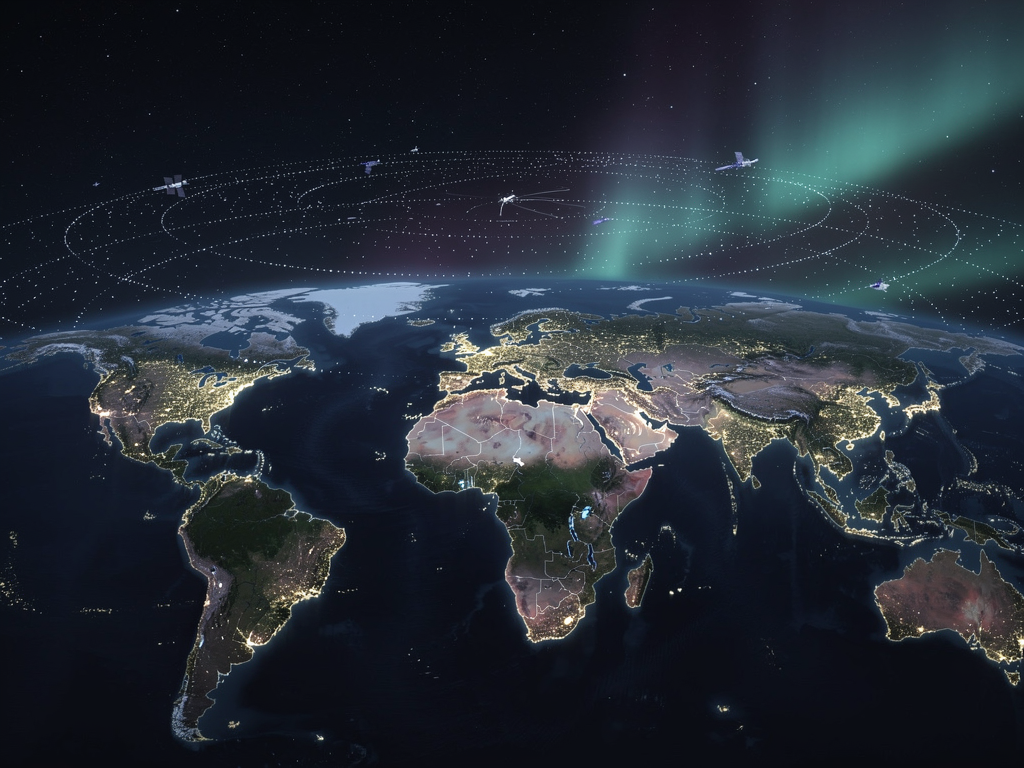
Starlink: Revolutionizing Global Internet Access in the 21st Century
In an era where connectivity is no longer a luxury but a necessity, the quest for universal, high-speed internet access continues. For many, especially those in rural or remote regions, reliable internet remains an elusive dream, hindering education, economic growth, and access to vital information. However, a revolutionary force is emerging from the cosmos: Starlink, SpaceX’s ambitious satellite internet constellation, is poised to redefine the landscape of global internet access. This groundbreaking technology promises to deliver high-speed, low-latency broadband internet to virtually any location on Earth, bridging the digital divide like never before.
The implications of widespread, accessible internet are profound. It empowers remote workers, enables telehealth services, facilitates online learning, and fosters economic opportunities in areas previously cut off from the digital world. Starlink’s approach, deploying thousands of small satellites in low Earth orbit (LEO), marks a significant departure from traditional geostationary satellites, offering a solution that is both faster and more pervasive. As we delve into the intricacies of this technology, we will explore its core components, its current impact, and its potential to shape the future of how the world connects.
Key Takeaways
- Starlink utilizes a constellation of thousands of satellites in Low Earth Orbit (LEO) to provide high-speed, low-latency internet.
- It aims to deliver reliable broadband to underserved rural and remote areas, bridging the global digital divide.
- Starlink offers a significant improvement over traditional geostationary satellite internet in terms of speed and latency.
- The service has expanded rapidly, impacting various sectors including education, remote work, and emergency response.
- Challenges remain, including regulatory hurdles, service costs, and environmental concerns regarding space debris.
- Starlink’s ongoing development and expansion signal a transformative shift in global internet accessibility.
Understanding Starlink’s Innovative Technology
At its heart, Starlink is a massive satellite internet constellation designed to provide global coverage. Unlike older satellite internet systems that rely on a few large satellites in geostationary orbit (GEO), Starlink deploys thousands of smaller, mass-produced satellites operating in Low Earth Orbit (LEO). This LEO approach is critical to its performance. Satellites in LEO are much closer to Earth, typically orbiting at altitudes between 350 and 1,200 kilometers, compared to GEO satellites which are around 35,786 kilometers away. This proximity drastically reduces the distance radio signals must travel, resulting in significantly lower latency – the delay between sending and receiving data.
The low-latency characteristic is a game-changer for applications that were previously impossible or severely hampered by satellite internet, such as online gaming, video conferencing, and real-time data processing. Furthermore, the sheer number of satellites ensures that users have a clear line of sight to a satellite at almost all times, regardless of their location. This continuous connectivity is achieved through a sophisticated network of ground stations that relay internet traffic to and from the satellites, ensuring a seamless experience. The user terminal, often referred to as the “dishy,” is a phased-array antenna designed to track and connect with multiple satellites simultaneously, automatically adjusting to maintain the strongest possible signal.
The Role of Low Earth Orbit (LEO)
The strategic deployment in LEO is fundamental to Starlink’s success. Traditional satellite internet often suffers from latency issues exceeding 500 milliseconds due to the vast distance to GEO satellites. Starlink, by contrast, aims for latencies between 20 and 40 milliseconds, comparable to terrestrial broadband services. This reduction in latency makes real-time interactive applications feasible, opening up new possibilities for users in areas without fiber or cable infrastructure. The constant movement of LEO satellites requires a large constellation to ensure continuous coverage, as a user’s connection will switch from one satellite to the next as they traverse the sky. SpaceX’s ability to launch these satellites rapidly using its Falcon 9 rockets is a key enabler of this ambitious project.
How the Starlink Network Operates
The Starlink network comprises three main components: the satellites in orbit, the ground stations, and the user terminals. Internet backbone traffic is routed to the ground stations, which then transmit the data up to the Starlink satellites. These satellites, equipped with inter-satellite laser links in newer versions, can also relay data directly to each other in orbit, further reducing reliance on ground infrastructure and enabling coverage over oceans and polar regions. The user terminal on the ground receives the signal from the satellite and transmits data back. The system is designed for user-friendly setup, with the dish automatically orienting itself to establish a connection. This integrated system ensures that even in the most remote locations, users can achieve internet speeds that were previously unimaginable.
Starlink’s Impact on Global Internet Access
The rollout of Starlink has already begun to make a tangible difference in regions struggling with inadequate internet connectivity. For millions living in rural communities, remote islands, and developing nations, Starlink represents a lifeline to the digital world. Schools in isolated areas can now offer online educational resources, students can participate in virtual classrooms, and teachers have access to professional development opportunities. This dramatically improves educational equity, providing opportunities that were previously out of reach due to geographical limitations.
Economically, the impact is equally significant. Remote work, once a privilege largely confined to urban centers with robust internet, is now a possibility for individuals in rural settings. This can help stem the tide of rural depopulation by allowing people to earn a living without leaving their communities. Small businesses can leverage online platforms for marketing, sales, and operations, expanding their reach beyond local markets. Furthermore, Starlink has proven invaluable in disaster relief scenarios, providing rapid communication capabilities when terrestrial infrastructure is damaged or destroyed. Its ability to be deployed quickly in crisis zones offers critical support for emergency responders and affected populations.
Bridging the Digital Divide in Underserved Areas
The ‘digital divide’ refers to the gap between those who have access to modern information and communication technology and those who do not. Starlink directly addresses this divide by targeting areas where traditional broadband infrastructure is economically unviable to deploy. For instance, in parts of Australia, Canada, and the United States with vast, sparsely populated territories, laying fiber optic cables is prohibitively expensive. Starlink offers a viable alternative, bringing speeds of up to 200 Mbps to these regions. This enhanced connectivity fosters local development, improves access to healthcare through telehealth, and ensures that citizens are not left behind in an increasingly digital society.
Use Cases in Education and Remote Work
Consider a remote Alaskan village where internet speeds were previously measured in kilobits per second, making even basic web browsing a challenge. Starlink has transformed this reality, enabling students to access online learning platforms and participate in collaborative projects. Similarly, professionals in remote agricultural or mining operations can now reliably connect for virtual meetings, access cloud-based tools, and maintain communication with headquarters. This democratization of access empowers individuals and communities, fostering innovation and economic resilience regardless of their physical location. The ability to conduct stable video calls is a significant improvement, enhancing both professional and personal connections for those living far from urban centers.
Challenges and Considerations for Starlink’s Expansion
Despite its transformative potential, Starlink faces significant hurdles as it expands its global reach. One of the primary challenges is the cost of service. The initial hardware purchase can be substantial, and the monthly subscription fees, while competitive for satellite internet, may still be out of reach for many individuals and communities in lower-income regions. Affordability remains a critical factor in achieving true universal access. Furthermore, regulatory approvals are required in each country where Starlink seeks to operate, a process that can be complex and time-consuming, involving spectrum allocation and compliance with local telecommunications laws.
Environmental concerns are also gaining prominence. The launch of thousands of satellites raises questions about space debris and the potential impact on astronomical observations. As the number of satellites in LEO increases, the risk of collisions and the creation of more debris grows, posing a long-term challenge for the sustainability of space activities. SpaceX is implementing measures to mitigate these risks, such as de-orbiting satellites at the end of their lifespan, but the sheer scale of the constellation warrants ongoing scrutiny and international cooperation. Additionally, the potential interference with existing radio astronomy frequencies is a subject of active discussion and research within the scientific community.
Cost and Accessibility Barriers
The upfront cost for the Starlink kit, which includes the user terminal, router, and mounting hardware, can range from a few hundred to over $500 in some markets. While this is significantly lower than previous satellite internet terminal costs, it remains a barrier for many potential users, particularly in developing countries. Monthly service plans also add to the ongoing expense. SpaceX is exploring ways to reduce these costs through economies of scale and potential tiered service offerings, but ensuring affordability for the most underserved populations is a complex economic and logistical challenge. Partnerships with local governments or NGOs might be necessary to subsidize access in certain regions.
Regulatory Hurdles and Environmental Impact
Gaining regulatory approval in over 100 countries is a monumental task. Each nation has its own telecommunications policies, spectrum management rules, and requirements for foreign service providers. Navigating these diverse regulatory landscapes requires significant investment and diplomatic effort. On the environmental front, astronomers have voiced concerns about light pollution from the satellites, which can interfere with ground-based telescopes. SpaceX claims that newer satellite designs are less reflective, and they are working with the astronomy community to minimize impacts. The long-term sustainability of mega-constellations like Starlink hinges on responsible space management and adherence to international guidelines.
The Future of Global Connectivity with Starlink
Starlink is not just about providing internet today; it’s about shaping the future of global connectivity. As the constellation grows and technology advances, we can expect even higher speeds, lower latency, and increased reliability. SpaceX is continuously iterating on its satellite design and user terminal technology, incorporating advancements that will enhance performance and potentially reduce costs over time. The company envisions a future where Starlink can serve as a primary internet source for homes, businesses, vehicles, and even aircraft, truly making the internet accessible everywhere.
The potential for Starlink extends beyond consumer broadband. It could revolutionize maritime and in-flight connectivity, offering speeds and reliability that have long been lacking in these sectors. Imagine seamless internet access on a long-haul flight or a remote research vessel, enabling productivity and communication previously impossible. Furthermore, Starlink’s infrastructure could support other applications, such as global asset tracking, environmental monitoring, and enhanced disaster response coordination. As the network matures, its integration with other technologies will likely unlock novel use cases that we can only begin to imagine today, solidifying its role as a cornerstone of future digital infrastructure.
Expanding Service Offerings
Beyond residential broadband, Starlink is actively expanding its service tiers. This includes ‘Starlink for RVs,’ offering portable connectivity for mobile users, and ‘Starlink Business,’ designed for higher-usage customers requiring guaranteed performance. Future plans include ‘Starlink Maritime’ for boats and yachts, and partnerships with airlines to provide in-flight Wi-Fi. These specialized services cater to diverse needs and demonstrate the versatility of the LEO satellite network. The ongoing development aims to make Starlink a ubiquitous connectivity solution across various environments and user types, ensuring that no corner of the globe is left unconnected.
Technological Advancements and Future Potential
SpaceX’s rapid innovation cycle is a key driver of Starlink’s future. Plans are already in motion for a second generation of Starlink satellites, which will be significantly larger and capable of higher bandwidth. These next-generation satellites will also feature more advanced laser inter-satellite links, improving network efficiency and enabling broader coverage, potentially even across the entire planet without the need for ground stations in certain areas. Furthermore, integration with other SpaceX initiatives, such as Starship, promises to dramatically increase launch capacity, accelerating the deployment of the full constellation and potentially lowering costs further. What Starlink represents is not just an incremental improvement; it’s a paradigm shift in how we conceive of and access the internet.
Conclusion: A Connected Planet Through Starlink
Starlink is undeniably transforming the landscape of global internet access, moving us closer to a world where reliable, high-speed broadband is universally available. By leveraging a vast constellation of satellites in Low Earth Orbit, SpaceX is overcoming the geographical and economic barriers that have long plagued traditional internet infrastructure. The technology offers a compelling solution for underserved rural and remote areas, empowering communities with unprecedented access to education, economic opportunities, and essential digital services. While challenges related to cost, regulation, and environmental impact persist, the ongoing innovation and rapid expansion of Starlink signal its profound and lasting influence.
The journey towards truly universal internet access is complex, but Starlink represents a monumental leap forward. Its potential to connect the unconnected, foster innovation, and bridge the digital divide is immense. As the constellation continues to grow and evolve, it promises to reshape industries, empower individuals, and fundamentally alter our global digital experience. Will Starlink be the key to unlocking a truly connected planet for everyone, or are there further innovations needed to overcome the remaining obstacles?